用 LetX 一起写 LaTeX。
LetX 是为学生和研究团队打造的免费在线协作 LaTeX 编辑器。几秒钟即可编译,实时协同写作,未发表的内容始终保持私密。
\documentclass{article}
\usepackage{amsmath}
\begin{document}
\begin{align*}
  e^{i\pi} + 1 &= 0 \\[1ex]
  \int_{0}^{\infty} e^{-x^2} dx &= \frac{\sqrt{\pi}}{2}
\end{align*}
\end{document}
真实编辑过程
邀请团队成员,实时共同编辑,几秒内编译生成 PDF。这就是 LetX 的实际使用体验。
Synergistic Application of Machine Learning and Computer Vision for the Detection of Exoplanets and Stars
Shihab Shahriar Antor Ashraful Kabir Alif
Department of Computer Science, BRAC University
Abstract. We present a framework that detects faint exoplanets in JWST/MIRI coronagraph imagery using contrastive and few-shot learning, separating planetary signals from bright host stars under low signal-to-noise. On held-out fields it outperforms CNN and GNN baselines while using far fewer labels.
Keywords: exoplanets, direct imaging, contrastive learning, few-shot learning, JWST
1. Introduction
Figure 1: JWST/MIRI direct imaging of a faint exoplanet (b) beside its host star.
Direct imaging of exoplanets is fundamentally limited by the overwhelming glare of the host star. Modern coronagraphs on JWST/MIRI suppress this stellar light, yet faint planetary signals remain buried in structured noise. As shown in Figure 1, the planet sits within the diffraction pattern of its star, making detection a needle-in-a-haystack problem. We cast this as a representation-learning task and show that contrastive objectives recover signals that pixel-wise classifiers miss.
2. Method
We learn a discriminative embedding with a contrastive objective, pulling together augmented views of one source and pushing apart star and planet candidates:
A few-shot head then adapts to new instruments from a handful of labelled detections, which is critical given the scarcity of confirmed direct-imaging targets.
3. Results
On held-out fields the model recovers 92% of injected planets at a false-positive rate below 0.1 per frame, outperforming CNN and GNN baselines by 14 and 9 points of recall respectively.
完成,图也显示出来了。随时可以重新编译。
全球高校的学生和教师都在使用
BRAC 大学、慕尼黑工业大学、汉堡大学、巴塞罗那加泰罗尼亚理工大学、渥太华大学,以及 75+ 个国家的 730+ 所高校与实验室,都有学生和研究人员在用 LetX 写作。
实时协作
实时协作写作。编辑会无冲突地合并,不必再通过邮件来回发送 .tex 文件或覆盖他人的修改,版本历史还能让你回到之前的草稿。
- 无冲突编辑(Yjs CRDT)
- 协作者不限:免费
- 版本历史
Direct Imaging of Exoplanets
Coronagraphs on JWST/MIRI suppress the host star’s glare, yet faint planetary signals stay buried in structured stellar noise.
We recover them with contrastive and few-shot learning, separating planet candidates from the star even at very low signal-to-noise.
能编辑文档的助手
用日常语言提出需求。Lexi 会阅读项目、提出修改、通过编译检查能否成功构建,并在当前编辑的位置应用修改。
这就是编辑器
你的文件,你的源码,你的 PDF。
画面里有文件树、LaTeX 源码、实时 PDF,还有和你一起编辑文档的其他人。Lexi 在编辑器底部待命,等你开口提需求。
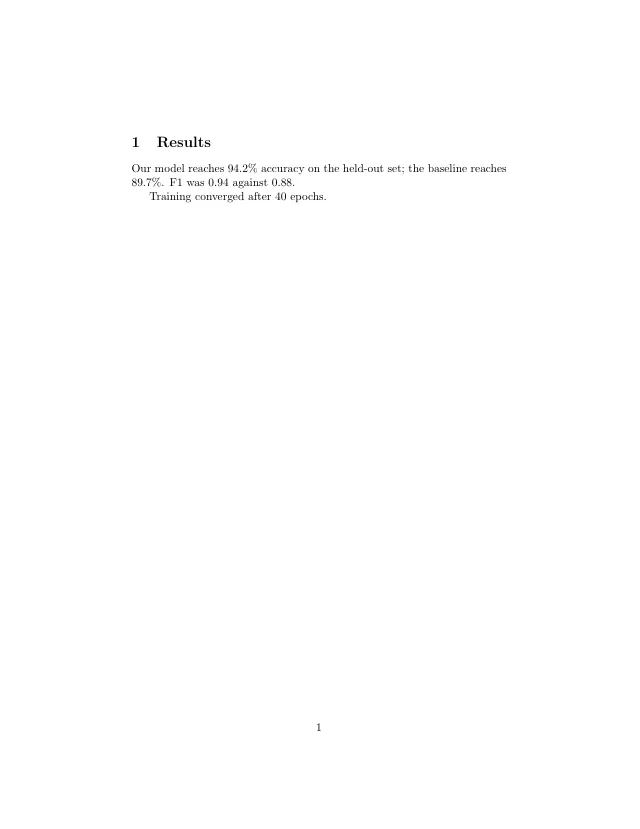
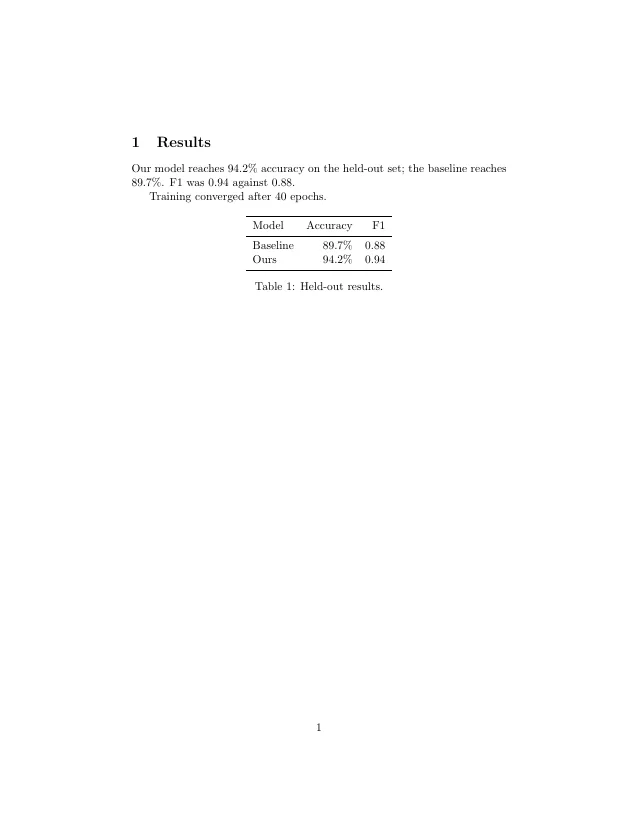
这是编辑器的复刻版,运行的是真实的工具调用序列。任选一个即可跳转到对应画面。
已经在 Claude 或 ChatGPT 中工作?LetX 已列入 Claude 连接器目录和 ChatGPT 插件目录,并运行一个 MCP 服务器,因此在付费套餐下,你的助手也能编译和编辑你的 LetX 项目。使用 Claude 时,免费账户可试用 7 天。
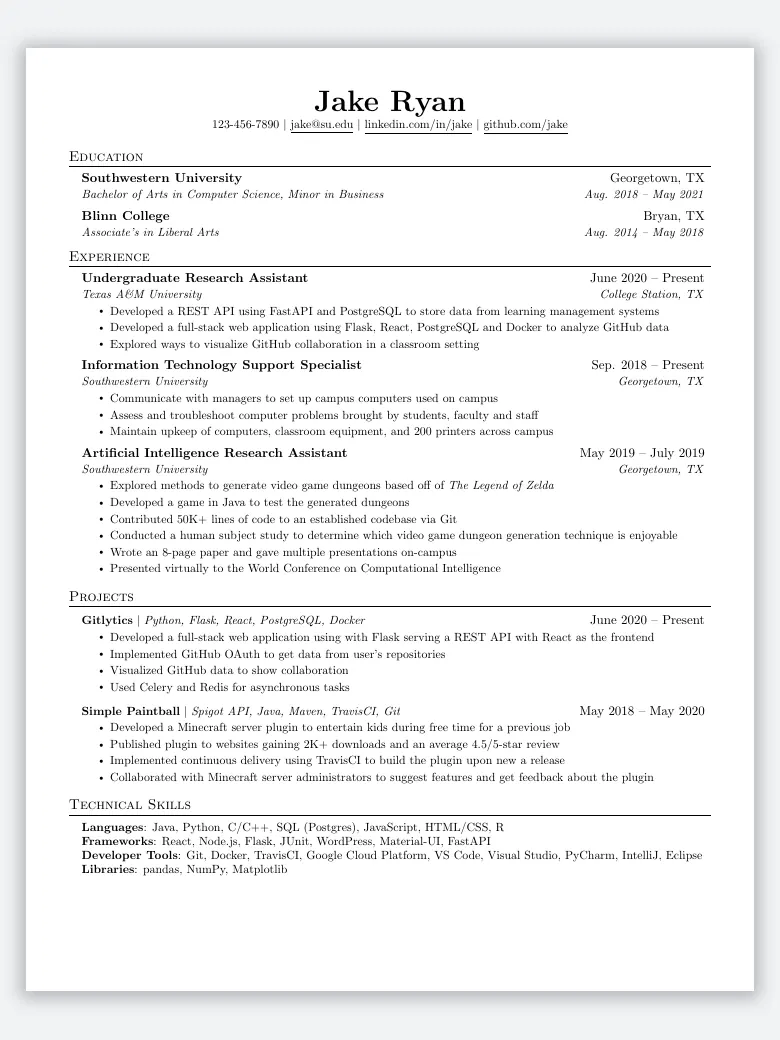
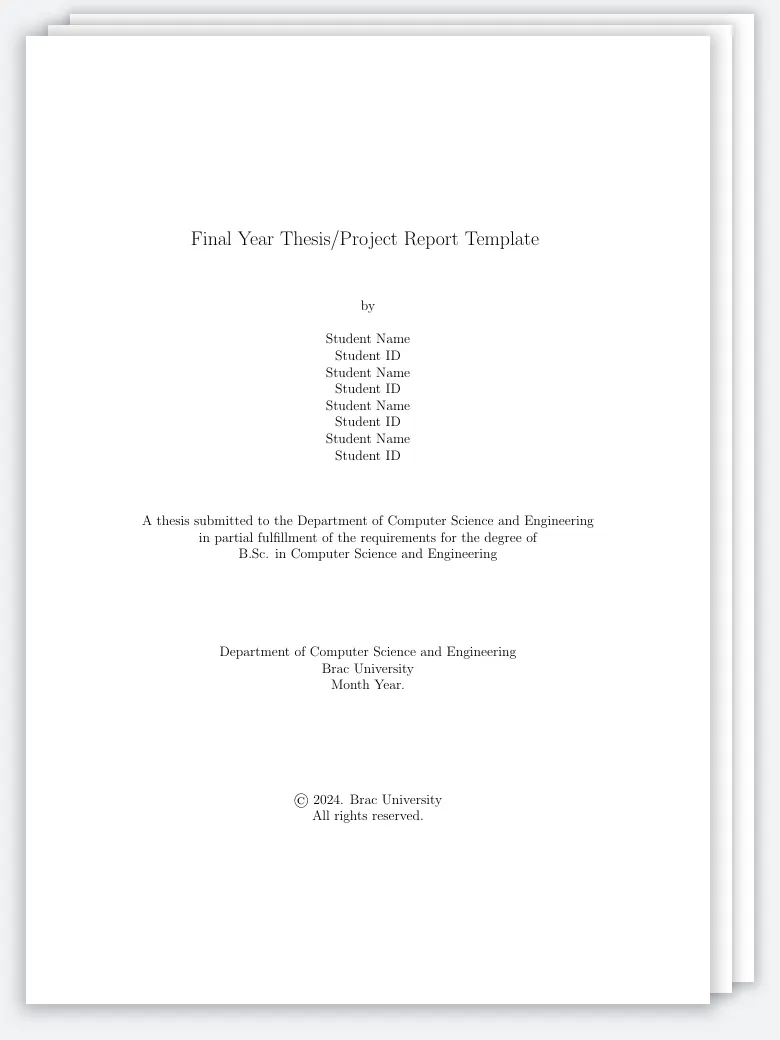
深受学生和教师喜爱
从动笔写论文前的实验室到教师办公室,BRAC 大学、麦吉尔大学以及其他高校的学生和研究人员,是这样评价用 LetX 写作的。
LetX 支持多人同时编辑,而且我还没有遇到过人数上限。
译自英文。姓名与所属机构保留本人提供的内容。
由研究人员打造,为研究人员服务。
消除写作障碍,加速科学发现。


联系我们
有疑问、反馈或需要帮助?欢迎随时联系我们。
发送消息
常见问题
关于在线协作式 LaTeX 编辑器 LetX,需要了解的信息都在这里。
LetX 是什么?
LetX 是一款免费的在线协作 LaTeX 编辑器,是可以直接在浏览器中运行、无需安装的 Overleaf 替代方案。团队可以实时共同撰写 LaTeX,几秒钟就能编译出 PDF,还能借助 SyncTeX 在源码与输出之间来回跳转。
LetX 是免费的吗?
是的。LetX 免费使用,项目数量和协作者人数都不限,每天可编译 40 次。与限制免费协作者人数的 Overleaf 不同,LetX 从不按协作者收费,Pro 还能取消每日编译次数限制。
LetX 与 Overleaf 有什么不同?
LetX 提供免费且不限人数的实时协作(Overleaf 的免费方案超过一位协作者就要收费),普通文档几秒即可完成编译,还有 1000 多个可直接使用的学术与简历模板。两者都在浏览器中运行,无需安装。
使用 LetX 需要安装什么吗?
不需要。LetX 完全基于网页,在 Mac、Windows 和 Linux 上的任何现代浏览器中都能使用。无需安装 LaTeX 发行版,编译在 LetX 的服务器上完成。
可以和别人实时协作吗?
可以。LetX 采用 Yjs CRDT 技术(与 Figma 属于同一类算法)实现无合并冲突的实时编辑。多人可以同时编辑同一份文档,并看到彼此的光标。
可以导入我现有的 Overleaf 或 LaTeX 项目吗?
可以。在“+ 新建项目”中,单个项目选择“以 zip 上传项目”,要一次迁移整个 Overleaf 或 Prism 导出则选择“导入多个项目”。
谁在使用 LetX?
75+ 个国家、730+ 所高校与研究机构的学生和研究人员都在用 LetX 写作。用户最集中的是 BRAC 大学、泗水国立大学、墨西哥国立自治大学(UNAM)、加州大学圣地亚哥分校和温莎大学。它被广泛用于学位论文、期刊论文和实验报告。